Persona Tenets
In this research, you will find various Web3 user persona archetypes and what drives them.
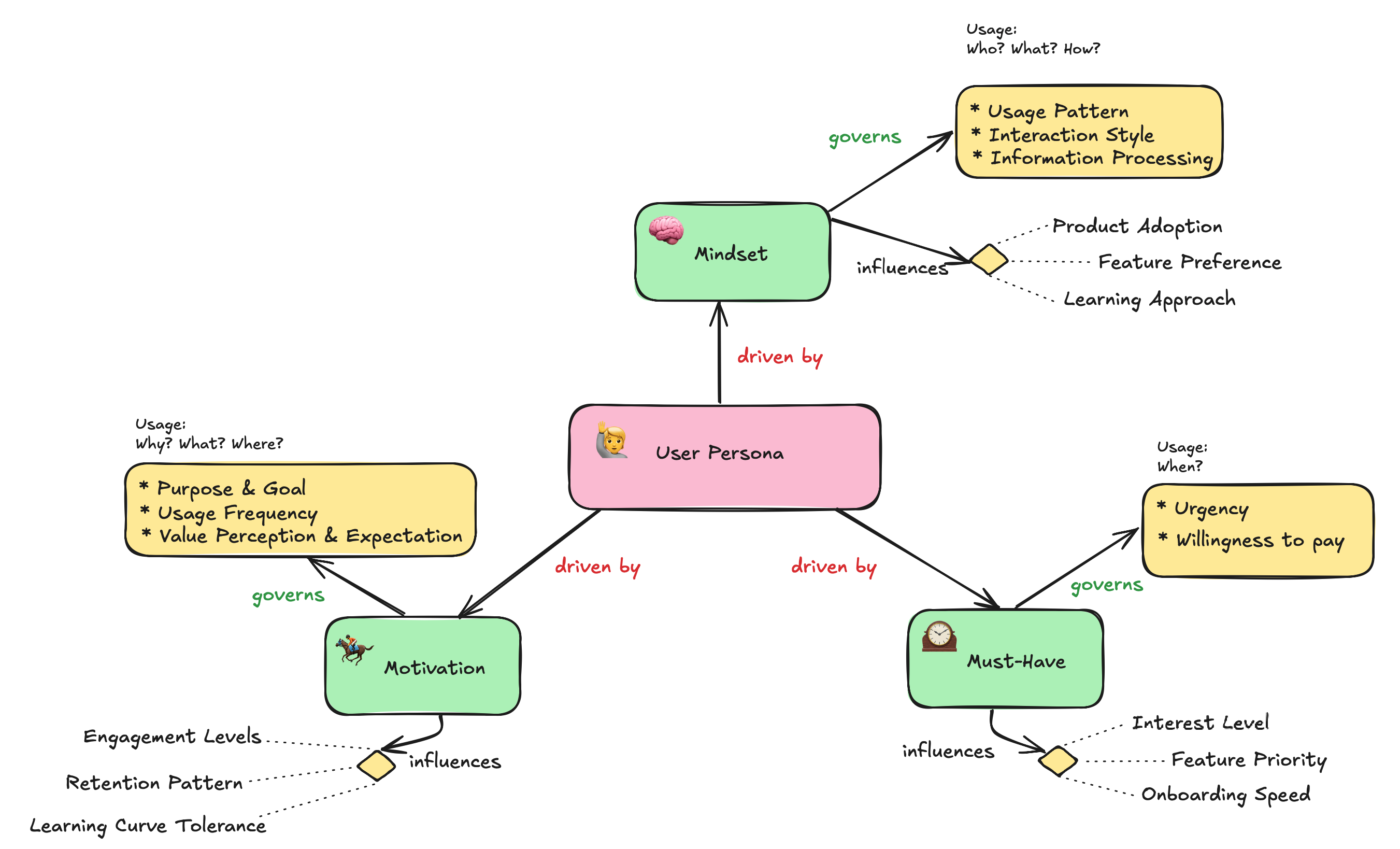
Following are the most basic and fundamental tenets that drive any user persona:
- Mindset
- Motivation
- Must-Have
These key tenets drive the Who, What, Why, Where, When and How of any products usage.
Next, let us explore how each of these tenets shape product usage, how they govern user's behavior, and influences user choices, ultimately impacting any product's market success.
Mindset
A user's mindset refers to the overall attitude, core assumptions and beliefs about oneself, others, and the world.
Mindset shapes how a user thinks, feels, and behaves. It works as a mental filter or frame of reference that influences one's perceptions and choices. Mindsets can evolve over time depending upon user's motivation and needs.
Usage: Understanding user's mindset informs who is using the product, how they are inclined to use it and what is the preferred usage pattern. Knowing about 'Who' informs product decisions about the level of the target audience. Whether they know more about the domain than the technology builders or nothing at all about what it can do for them. This detail informs whether users need to be provided with some basic information to enable product usage or will too much basic information come in the way of product adoption.
Governs: Mindset governs product usage patterns, how a user interacts with the product and their preferred mode of information processing. For example, users with fixed mindsets may not be tolerant to a steep learning curve unlike those with a growth mindset.
Influences: Mindset can influence how a product is adopted, what features are preferred or expected, and what kind of learning approach could click for a new product or feature. This not only informs the builders and designers but also product documentation and marketing.
Motivation
Motivation is the intrinsic or extrinsic force that can drive human behavior. It is at the root of why people initiate, continue, or end actions to achieve a goal.
Usage: Understanding user's motivation informs why they use a feature or product, what kind of pain points it solves and where or in what context a product or feature is needed. For example, the answer to 'Where' could provide information about whether is it something that will be used through a desktop or mostly via a mobile device?
Governs: Motivation governs the purpose or goal of a product's usage, the frequency of use, and its perceived value. It also governs user expectations regarding the ease of use, performance, and effectiveness.
Influences: User's motivation influences a product's engagement levels, retention patterns, and how sensitive they may be to a new use model or learning curve.
Must-Have
Must-Have refers to the degree of the user's need or requirement and hence the timelines or window of opportunity that builders can leverage.
Usage: Understanding the must-have aspect of a persona's tenet helps answer the question of when or the timing aspect of any product's engineering and usage.
Governs: The must-have tenet governs the urgency and willingness to pay for a product or a feature.
Influences: Understanding the must-have user persona tenet can impact the user's interest level in a product or a new feature. It can help align the product roadmap and provide guidance on the available time window.
Builders can prioritize features that align with true must-haves. A clear understanding of a user’s non-negotiables directly affects onboarding speed, and ultimately reduces the time and effort needed to streamline or simplify the onboarding experience.