Personas
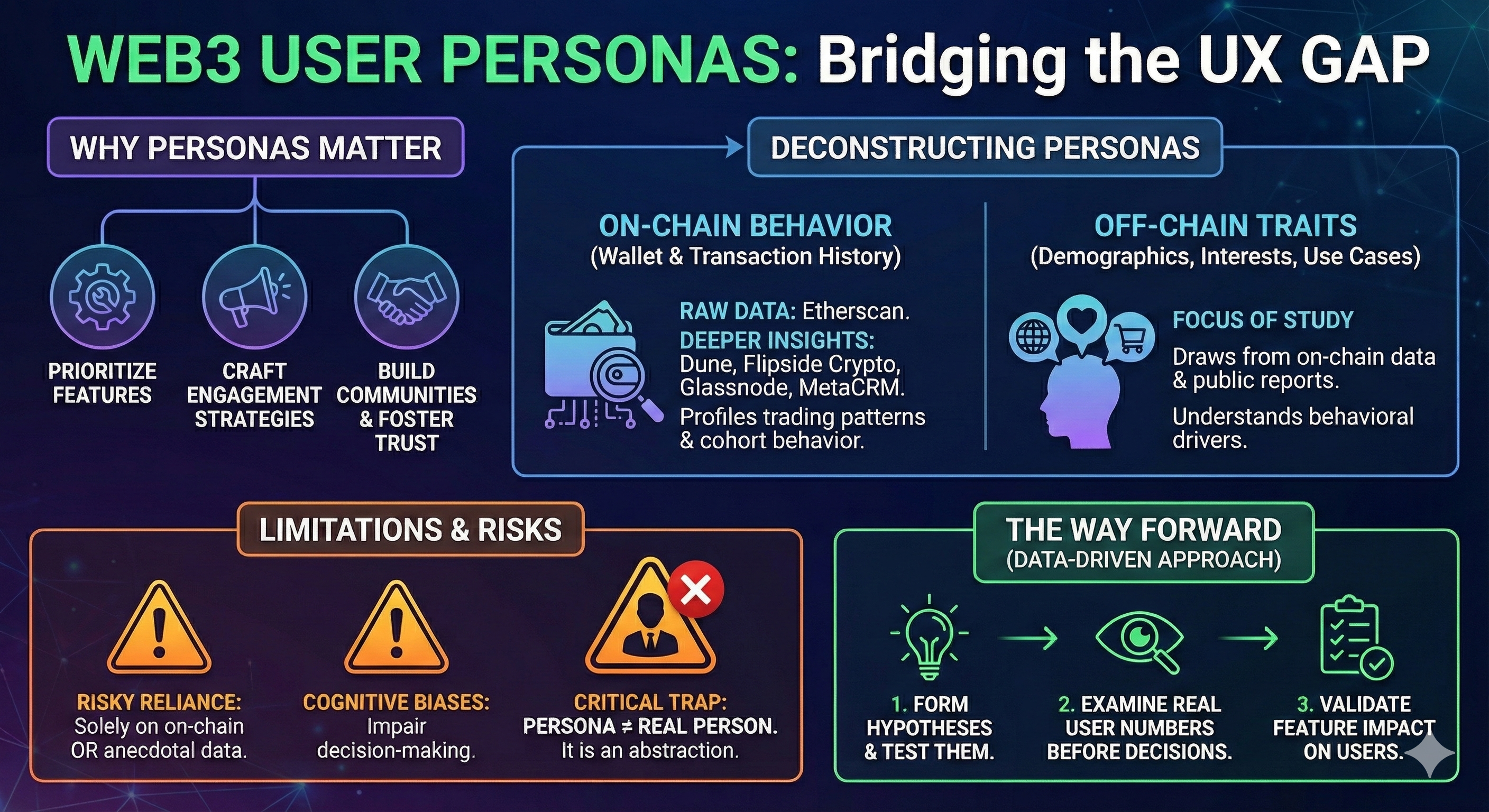
A persona is an abstraction of an individual. It creates a semi-fictional profile representing an ideal user for a product or service.
Web3 often struggles with optimal user experiences. Understanding the target audience helps builders prioritize features. It enables them to craft engagement strategies. It helps them build communities and foster trust.

Deconstructing Personas
Building Web3 user personas relies on two data types:
- On-chain behavior (wallet activity, transaction history)
- Off-chain traits (demographics, interests, use cases)
Basic block explorers like Etherscan and chain-specific tools provide raw on-chain user behavior data. Specialist analytics platforms like Dune, Flipside Crypto, Glassnode, and MetaCRM offer deeper insights. They profile trading patterns, cohort behavior, and chain-specific growth.
This study focuses on off-chain Web3 user behavior. Our analysis draws from on-chain data and public reports. It equips Web3 builders and content provider with essential knowledge. They learn about user personas and behavioral drivers. They also learn how these factors impact product viability and traction.
Cornerstones
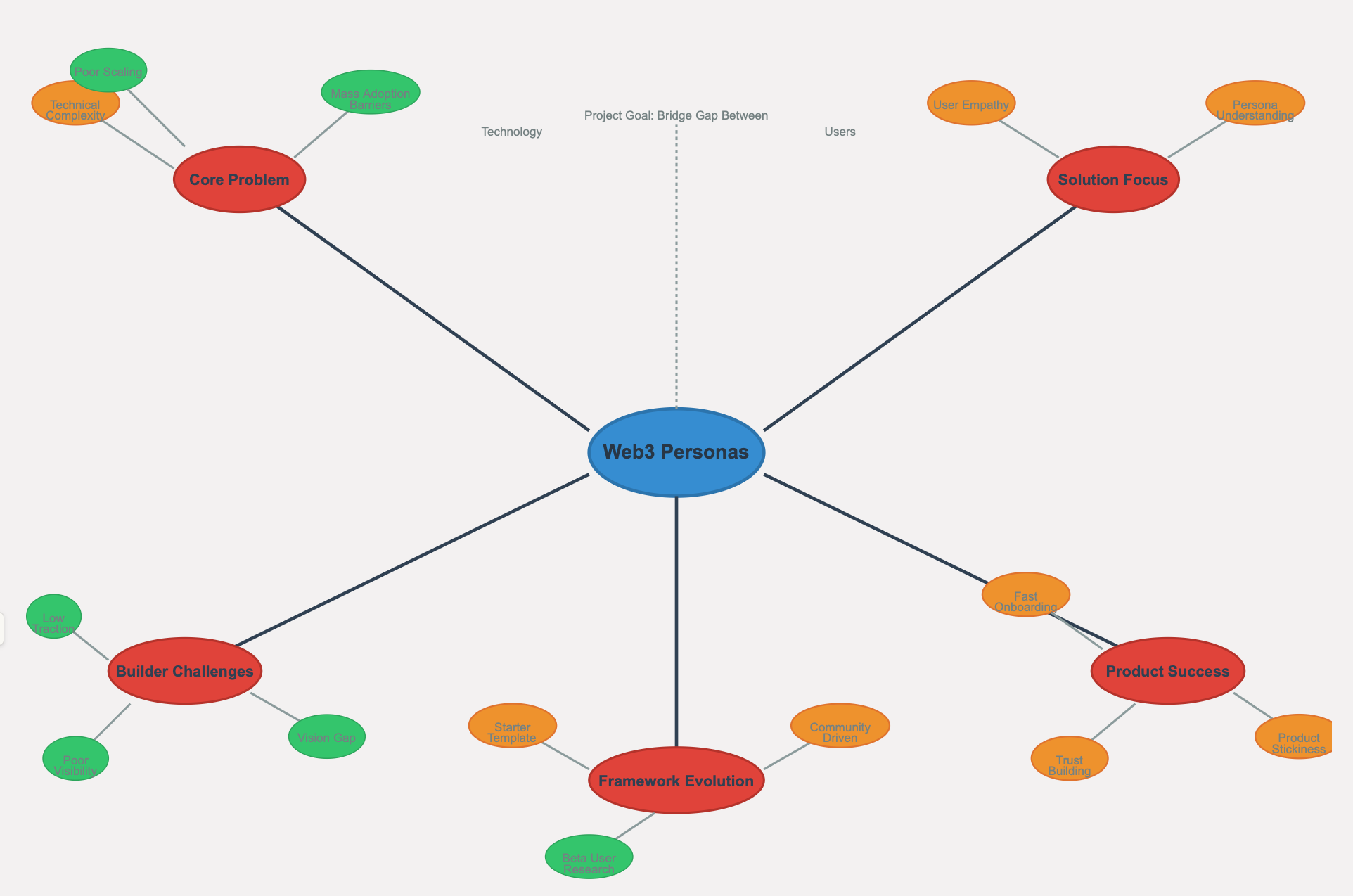
This study is built around the following core foundations. These foundations define the problem scope, the proposed solution, and the path to continued success within the Web3 ecosystem.
- Core Problem: Mass adoption barriers, technical complexity, poor scaling
- Builder Challenges: Low traction, poor visibility, vision gaps
- Solution Focus: User empathy, deep understanding of personas and how they are evolving
- Product Success Levers: Fast onboarding, fostering trust, product stickiness
- Continuous Evolution of Web3 User Personas Framework: Starter framework, informs product specific user persona template, collaborative and community led refinement
Based on extensive off-chain research and publicly available reports, this study identifies the core Web3 persona tenets, maps the primary and sub-types of persona archetypes, and introduces a structured persona template. This template enables deeper insight into each defined Web3 user persona and serves as a systematic way to understand how they think, behave, and make decisions.
Limitations
In Web3, 'Knowing Your Users' (KYU) matters as much as KYC does for financial compliance. Cognitive biases and conjunctive fallacies can impair decision-making.
Relying solely on on-chain behavior is risky. Using only anecdotal data or gut instincts is also risky. This approach drives products away from real market demands. It ruins acceptance and traction.
We must avoid a critical trap. Don't assume personas represent actual people.
A persona is not a real person.
What is the way forward?
- Form hypotheses, then test them.
- Examine real user numbers before making decisions.
- Validate how many users will get affected by a feature or documentation change.
Click here for further insights on:
- What drives user personas?
- What engages or disengages them?
- How can alignment with user behavior impact product viability?
- How does it affect adoption?
- Why is understanding user personas critical?
- How does this apply when developing new technology or solutions for Web3?